
Screen-Time Limits in Schools: The 2026 State Laws and What They Mean for K-5 Classrooms
Screen time in schools moved from a parent conversation to statute in 2026. Four states enacted laws that directly restrict or regulate device use for students from childcare through fifth grade, six states enacted screen-time-related legislation in total, and the country's second-largest school district adopted limits by board vote. At least sixteen states introduced bills. Several high-profile proposals passed one chamber and then died.
This article sets out what was actually enacted, what each law requires, when it takes effect, and what is still pending. It is a summary of public policy documents, not legal advice; districts should work from their own state guidance and counsel.
What Changed in 2026
The distinction that matters most is between laws that restrict classroom device use and laws that touch screen time in some other way.
Four states enacted laws directly restricting or regulating screen time for students from childcare through grade five: Iowa, Utah, Tennessee, and Alabama.
Two more enacted related legislation without classroom restrictions: Virginia, which requires instruction about time spent on electronic devices and their addictive potential, and Maine, which directed a research institute to study classroom technology use. Counting these, trackers record six states with enacted screen-time-related legislation in 2026. EdWeek Market Brief counts seven when executive directives are included.
One major district acted independently: Los Angeles Unified, by board resolution in April 2026.
State by State, With Effective Dates
| State | Instrument | What it requires | Effective |
|---|---|---|---|
| Iowa | HF 2676, signed May 20, 2026 | Caps digital instruction at 60 minutes per school day for grades K-5; school boards must adopt a K-5 technology policy and publish one-to-one device programs; creates a working group on grades 6-12 | July 1, 2026 |
| Utah | HB 273, signed March 18, 2026 | Directs the State Board of Education to issue model technology policies including screen-time restrictions in grades K-3 and limits on one-device-per-student ratios in elementary school | July 1, 2026; model policies due December 1, 2026 |
| Tennessee | SB 2310 / HB 2393, signed April 21, 2026, Public Chapter 808 | Every LEA and public charter school serving K-5 must adopt a policy governing the age-appropriate, instructional use of digital devices to minimize unnecessary screen time | July 1, 2026 |
| Alabama | HB 78, Healthy Early Development and Screen Time Act, signed March 4, 2026 | Directs the Department of Early Childhood Education, with the Department of Human Resources and the State Department of Education, to develop guidelines for screen-based media in early childhood programs, day care settings, pre-K and kindergarten, plus a staff training program; local boards to adopt kindergarten policies by the 2027-28 school year | January 1, 2027 |
| Virginia | SB 568, Acts of Assembly Chapter 319, April 6, 2026 | Amends Code of Virginia section 22.1-206 to require instruction about time spent using electronic devices and their addictive potential | In force |
| Maine | LD 2052 (HP 1376), Resolve Chapter 149, signed April 3, 2026 | Directs the Maine Education Policy Research Institute to survey schools on classroom technology use and safeguards and report with recommendations | Report due December 1, 2026 |
Iowa is the most prescriptive of the four, setting an actual daily cap. Its exceptions cover technology required by an individualized education program or Section 504 plan, state assessments, assistive technology, and computer science instruction.
Utah takes the model-policy route: the legislature directed the state board to write the rules rather than writing them itself. The bill took effect July 1, 2026, but the operative classroom detail arrives with the board's model policies, due December 1, 2026.
Tennessee requires local adoption without specifying minutes. Public Chapter 808 carves out accommodations required under IDEA, Section 504, or the ADA, along with specified state-required screeners and assessments, and does not apply to targeted instructional support, intervention, or remediation.
Alabama is aimed primarily at early childhood settings rather than elementary classrooms, and its requirements are not yet operative. The classroom-facing provisions take effect January 1, 2027, with local kindergarten policies due by the 2027-28 school year. A July 2026 executive order created a commission to study screen-based learning.
One difference worth flagging for special education teams: Iowa, Tennessee, and Utah include explicit carve-outs protecting technology required by a student's IEP or 504 plan. Alabama and Virginia do not contain equivalent language.
District Policies: Los Angeles Unified
Los Angeles Unified adopted classroom screen-time limits by board vote in 2026. The board approved a resolution on Tuesday, April 21, 2026, by 6-0 with one recusal. The resulting policy, approved in June for the 2026-27 school year, bars district-issued devices for early education through first grade and limits grades 2 through 5 to 60 minutes per day or 300 minutes per week.
District action of this kind matters beyond the district itself, because large districts function as a reference point for boards elsewhere writing their own policies.
Bills That Did Not Pass
Several proposals with strong momentum failed before their sessions ended:
- Oklahoma HB 4358, a 60-minute cap, which passed the House 95-0 and cleared a Senate committee 8-0
- Missouri HB 2230, a 45-minute cap, which passed the House 143-10
- Kentucky SB 318, a 45-minute cap
- Kansas SB 350, a K-5 device prohibition
The Kansas state board is expected to issue guidance by November 2026, and New Hampshire launched a task force in August 2026.
What the Laws Require of Principals
Where a law applies, the operational burden tends to fall in four places:
A written policy. Iowa requires each school board to adopt a K-5 technology policy. Tennessee requires every district and charter serving K-5 to adopt one. Utah's model policies will shape local policies once issued. Someone in the building has to know what the policy says.
Tracking, or a defensible approach to it. A daily cap implies some way of knowing whether instruction is within it. Few schools have instrumented this, and minute-counting across a day is harder than it sounds.
Documented exceptions. IEP and 504 accommodations, assessments, assistive technology, and computer science instruction are carved out where the statute says so. Those exceptions need to be applied deliberately rather than assumed.
Instructional substitution. A cap on digital instruction is, in practice, a requirement to teach the same content another way for part of the day. This is where the policy stops being an administrative matter and becomes a planning question for teachers.
An observation that comes up in the policy debate and is worth carrying into local conversations: several people working on these bills have argued that minutes are a blunt instrument, because interacting with a learning tool and passively consuming content are not equivalent uses of the same minute. States have largely written minute-based rules anyway, so schools will be complying with minutes while having a more nuanced internal conversation about quality.
Print and Hands-On Materials in Compliance Planning
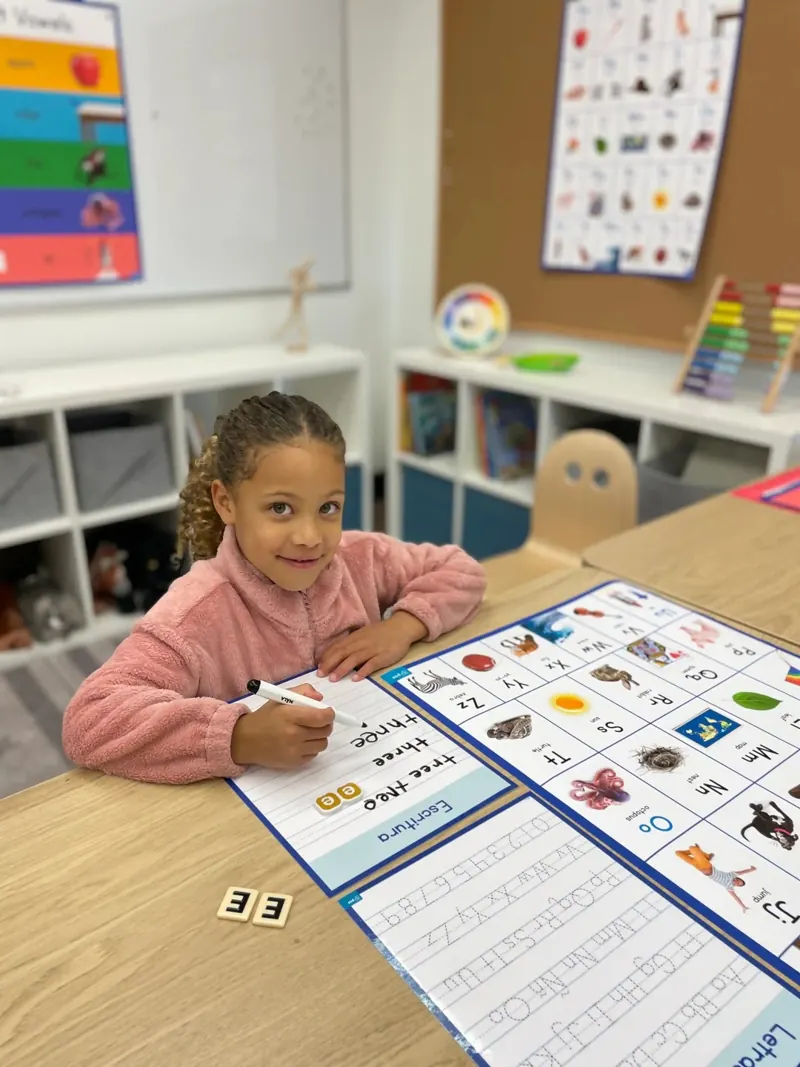
Where digital minutes come down, something replaces them. Schools working through this have generally leaned on materials that were already part of good elementary practice: anchor charts that stay visible on the wall rather than a slide that disappears, printed reference materials at student tables, word walls and number lines, manipulatives, and physical student work on display. For more display ideas, see school poster ideas.
The practical constraint is production. A teacher who wants a wall-sized reference chart either makes it by hand, projects it, or prints it. Projecting it is a screen. Making it by hand takes an evening. Printing it at display size requires access to a wide-format printer, which is why some schools revisiting device policy have also revisited how they produce print materials.
This is not a compliance solution and should not be presented as one. Policies require policies, tracking, and instructional planning. Print materials are one input into the instructional substitution question, not an answer to the legal one.
What to Watch in 2027
Three dates are already on the calendar: Utah's model technology policies, due December 1, 2026; Maine's MEPRI report, also due December 1, 2026; and Alabama's January 1, 2027 effective date, with local kindergarten policies due by the 2027-28 school year. Kansas state board guidance is expected by November 2026.
Developments as of October 17, 2026. Since the state-by-state details above were verified in September, the Utah State Board of Education has circulated a draft model policy (October 8, 2026) that, for kindergarten through grade 3, allows no classroom screen time except to introduce state computer science standards or to prepare for and take a standards assessment, and directs instruction toward hands-on, print-based activities. Under the board's 2026 legislative summary, local education agencies must adopt the model policy, or an amended version, before July 1, 2027. In Texas, Governor Greg Abbott said on October 9, 2026 that he will seek to reduce classroom screen time in the next legislative session, without yet specifying grades or limits, as reported by FOX 4.
How PSS Supports Paper-Based Instruction
PSS K12 has supplied poster maker systems to K-12 schools since 1994 and reports more than 2,900 schools using them. The PSS Poster Maker System is a 24-inch wide-format printer with a workstation, software, and support, used by schools to produce anchor charts, behavior signage, hallway displays, and bilingual classroom visuals in house. The Principal's Every-Wall Plan adds twelve months of unlimited paper and ink.
Frequently asked questions
Which states have limited classroom screen time?
Four states enacted laws in 2026 directly restricting or regulating screen time from childcare through grade five: Iowa, Utah, Tennessee, and Alabama. Virginia and Maine enacted related legislation without classroom restrictions, bringing the count of states with enacted screen-time-related laws to six.
What is Tennessee's screen time law?
Public Chapter 808, from SB 2310 and HB 2393, requires every local education agency and public charter school serving grades K-5 to adopt a policy governing the age-appropriate, instructional use of digital devices to minimize unnecessary screen time. It was signed April 21, 2026 and took effect July 1, 2026, and authorizes device use for accommodations required under IDEA, Section 504, or the ADA, and for specified state-required screeners and assessments.
What is Iowa's classroom screen time law?
HF 2676, signed May 20, 2026 and effective July 1, 2026, caps digital instruction at 60 minutes per school day for grades K-5, with exceptions for IEP and 504 plans, state assessments, assistive technology, and computer science instruction. It also requires each school board to adopt a K-5 technology policy.
When does Alabama's screen time law take effect?
Alabama HB 78 was signed March 4, 2026 and takes effect January 1, 2027. Local boards must adopt kindergarten screen-time policies by the 2027-28 school year, so its classroom requirements are not yet operative.
Did any major school district limit screen time?
Yes. Los Angeles Unified approved a resolution on April 21, 2026, and adopted a policy in June for the 2026-27 school year barring district-issued devices through first grade and capping grades 2-5 at 60 minutes per day or 300 minutes per week.
Do screen time laws apply to students with IEPs?
Iowa, Tennessee, and Utah include explicit carve-outs for technology required by an IEP or Section 504 plan. Alabama and Virginia do not contain equivalent language. Check your own state's statute and district guidance.
Sources
- Alabama Governor's Office, "Governor Ivey Signs Screen Time Limits for Early Childhood Education Programs into Law," March 4, 2026, including the January 1, 2027 effective date: https://governor.alabama.gov/newsroom/2026/03/governor-ivey-signs-screen-time-limits-for-early-childhood-education-programs-into-law/
- Los Angeles Unified Board of Education, Regular Board Meeting, April 21, 2026, with Tab 21, "Using Technology with Intention: Establishing Guidelines for Student Screen Time" (final amended): https://boe.lausd.org/apps/events/2026/4/21/29778109/?id=0
- Stateline, "States move to limit classroom screen time," July 23, 2026: https://stateline.org/2026/07/23/states-move-to-limit-classroom-screen-time/
- MultiState, "Elementary School Screen Time Limits Gain Momentum in 2026," April 8, 2026: https://www.multistate.us/insider/2026/4/8/elementary-school-screen-time-limits-gain-momentum-in-2026
- Whiteboard Advisors, "Screen Time Legislation Is Moving Fast. Here's What's Actually Enacted," May 18, 2026: https://whiteboardadvisors.com/screen-time-legislation-is-moving-fast-heres-whats-actually-enacted/
- : https://www.govtech.com/education/k-12/classroom-screen-time-draws-attention-of-state-lawmakers
- Progress Learning, "Adapting to New Screen Time Laws in Schools by State," June 2026 (LAUSD board vote and failed bill vote margins): https://progresslearning.com/news-blog/screen-time-laws-in-schools/
- Iowa Legislature, HF 2676 bill history and text: https://www.legis.iowa.gov/legislation/BillBook?ba=HF2676&ga=91
- Utah Legislature, HB 273 enrolled copy, including the July 1, 2026 effective date: https://le.utah.gov/Session/2026/bills/enrolled/HB0273.pdf
- Tennessee General Assembly, SB 2310 bill history, including the April 21, 2026 governor signature and the July 1, 2026 effective date: https://wapp.capitol.tn.gov/apps/Billinfo/Default?BillNumber=SB2310&ga=114
- Tennessee Secretary of State, Public Chapter 808 text: https://publications.tnsosfiles.com/acts/114/pub/pc0808.pdf
- Tennessee General Assembly, SB 2310 / HB 2393 fiscal memorandum (bill summary as amended, K-5 policy requirement and exemptions): https://www.capitol.tn.gov/Bills/114/Fiscal/FM1801.pdf
- Virginia LIS, SB 568 as chaptered, Acts of Assembly Chapter 319: https://lis.virginia.gov/bill-details/20261/SB568/text/CHAP0319
- Maine Legislature, LD 2052 documents and disposition, Resolve Chapter 149: https://legislature.maine.gov/legis/bills/display_ps.asp?LD=2052&snum=132
- Maine Legislature, LD 2052 enacted text, including the December 1, 2026 report deadline: https://legislature.maine.gov/legis/bills/getPDF.asp?paper=HP1376&item=3&snum=132
- PSS Poster Maker System: https://pssk12.com/poster-maker
- The Principal's Every-Wall Plan: https://everywall.pssk12.com
- Utah State Board of Education, Instructional Technology and AI Model Policy, draft 2, October 8, 2026: https://www.utah.gov/pmn/files/1497247.pdf
- Utah State Board of Education, 2026 Legislative Summary (LEA adoption deadline): https://schools.utah.gov/policy/_policy_/_utahlegislativesession_/_2026_/LegislativeSummary_2026_V4.pdf
- FOX 4, "Abbott calls for elimination of screen time in Texas classrooms," October 2026: https://www.fox4news.com/election/greg-abbott-screen-time-ban-texas-schools